“Always Anxious, Always On Guard? What My Body Was Trying to Tell Me”
I’ve always known the story of my birth. Not in a dramatic, whispered, “we never talk about that” kind of way. The opposite, actually. My birth was always told like a family story—full of detail, almost celebratory. My parents, my grandparents… everyone had something to add. The days leading up. How my mom knew she was in labor. The drive to the hospital. The fact that my dad was the first father allowed in the delivery room at that hospital.
They had taken natural birthing classes. They were prepared. Educated. Ready, in all the ways new parents can be.
My due date came, and voilà—I was born midday on a hot August day.
And the story, as it was told to me, was never framed as traumatic. There were details, yes. But they were softened. Or maybe just understood differently at the time. Maybe no one knew what was happening from my side of the experience. From inside the body that was trying to make its way into the world.
Because something did happen. I just didn’t know it for a long time.
Random or not-so-random quirks?
Even as an adult, I have this… thing.
I put my shirts on backwards. A lot. Not occasionally. Not in a quirky, “oops, I wasn’t paying attention” kind of way. It’s like something between my brain and my body gets crossed. Even when I check the tag, even when I slow down, I can still get it wrong.
And taking shirts off? That’s where it gets weirder. I have to do it the same way every single time. Arms out first—pulling each sleeve carefully—then lifting the shirt up and over my head, and making sure I hold the collar open with my hands.If I don’t—if I try to just grab the bottom and pull it up and off in one motion, like most people do—I get stuck. And I don’t mean mildly inconvenienced. I mean full panic.
Spinning. Thrashing. Fighting. Disoriented. I can’t find my way out. I can’t breathe. I don’t know which way is up or down. It escalates so quickly that I sometimes need help to get out of my own shirt. I am a very adulty adult. And I still sometimes get stuck in my clothes.
Something else seems odd now that I think about it-
I’ve been in the water my whole life. Swimming since I was little. Junior lifesaving. Lifeguard. Managed a pool in college. I am completely at home in water. And yet- I can’t dive.
Not for lack of trying. Not for lack of coaching. I understand the mechanics perfectly. Chin tucked. Body aligned. Reach forward. Enter clean. I could do everything right. I would stand there, ready, chin to chest, holding the position exactly as I was taught, I can even remember hearing my coaches voice. And then—every single time—right as my hands hit the water, my chin would lift.
And I would face plant. And it didn’t matter how deep the water was. How high the board. How many times I practiced. My body would not let me lead with the crown of my head. It wasn’t a skill issue. It wasn’t a fear of water. It was something deeper. Something instinctive. Something my body would not override- my body was holding trauma.
When did I know?
I grew up with incredibly loving and kind parents. When I was a kid, my dad used to grab my face in his hands, gently squishing my cheeks together, and say, “This is what you looked like the first time I saw you.” Then he’d kiss my forehead, right where my birthmark is. As a little kid, I’d giggle. As I got older, I’d roll my eyes in that way kids do. But it stuck with me. That image. That knowing.
Because I’ve always known how I was born- I was born facing up.
Babies are supposed to come out facing down. Chin tucked. Turning slightly to align the shoulders. The crown of the head presenting first—the part designed to mold, to compress, to move through the birth canal. You’ve probably seen it before—a newborn with that slightly cone-shaped head. That’s normal. That’s the body doing exactly what it’s designed to do.
That’s not what happened for me.
I was born occiput posterior—facing up, with the back of my head against my mother’s spine. My chin wasn’t tucked—it was extended, reaching upward. My presenting part wasn’t the crown of my head. It was my face. And I got stuck. Stuck in a way that required my mom to push and push until she was exhausted. The doctor, knowing the risks of the situation, eventually told her to push as hard as she could and not stop until he told her she could. He reached for forceps. And if you know my mom, you know she’s not one to give up easily. She pushed me out on that next push.
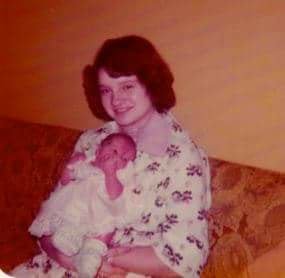
A few days old, you can see, even in this grainy photo, how much bruising was on my face and head. Though it has faded, the stain is still there today.
But was it trauma?
This is the part where we usually decide whether something was traumatic. But here’s the truth that shifted everything for me:
Trauma is not the event. It’s the perception of the event.
My parents don’t carry this as trauma. It wasn’t traumatic for them in the way we might define it now. It was intense, yes. Hard. But also empowering. My mom did it. She got me out. From their perspective, it’s a story of strength and joy- and I’ve known that too. But from my body’s perspective? It was something else entirely.
Because inside that experience, I was trying to get out—and I couldn’t. Confused. Stuck. My body was working and fighting as hard as it could to complete a process it was designed to complete, and it couldn’t find the way. And when a body can’t complete something that essential—something that primal—it doesn’t just forget.
Emotions are sticky
For most of my life, I didn’t know any of this. I just knew that I felt… anxious all the time, everything felt like I was under attack and needed to defend and fight. I’ve been told I’m a “rebel”, that I need to do things my own way, and even that I have a “different perspective” on things than other people. I rarely know what they mean when they tell me these. And then there’s the underlying sense of urgency in me and impending doom. A literal hum of anxiety that didn’t always have a clear cause. A feeling of being trapped or overwhelmed that would show up in moments where it didn’t quite make sense. I couldn’t point to a story that explained it.
But my body could.
What I’ve come to understand through somatic work is that my nervous system has been in a state of what’s called “global high activation.” During my birth, my body didn’t know what to do. What was supposed to be innate—automatic, guided—didn’t line up. It was like I had a map, but I couldn’t find myself on it. The star that was supposed to say “you are here” wasn’t where I actually was, so I couldn’t figure out how to get where I needed to go. And in that confusion, my body did the only thing it could—it held, it braced, it fought, it guarded, and it tried ways to get out that other babies don’t have to do.
That became the pattern. Not because it was always needed, but because it worked in that moment. And so, for years, even the slightest activation in my system would bring me right back there—defensive, pushing, fighting, trying to find my way out.
Bodies don’t process things the way our minds do. Because I have never once in my life thought my coming into this world caused anyone involved to be traumatized- I know that. But my body holds a different story.
Our body doesn’t lie to us
Here’s the part that feels both the most strange and the most incredible to me:
Our bodies loop and create patterns. They try to complete what couldn’t be completed. My body has been trying to complete that birth process for decades. Not consciously. Not in a way I could name. But through patterns. Through movements. Through moments of getting stuck and trying, over and over again, to find a way through. Bodies don’t give up on completion.
That moment when I get stuck in my shirt? That’s not random. That’s my body back in a place where it can’t find the way out. That panic? The disorientation? The inability to breathe or orient? That’s the same pattern.
And the diving? My chin lifting at the last second, refusing to tuck? That’s my body saying, “We don’t go that way. We go this way instead.” Even if my conscious mind knows better. Even if I’ve practiced for hours. The body remembers what it learned when it mattered most and it repeats.
They just keep looking for a safe way to do it. I didn’t know my birth was something my body was still holding. How could I? No one had ever framed it that way. But once I learned about birth from the baby’s point of view—from the inside out—something clicked.
Slowly. Gently. With support.
Because another truth I’ve come to understand is this: Healing doesn’t happen in isolation. The presence of an empathetic witness is not optional. When I work with a somatic practitioner, I’m not being “fixed.” I’m being accompanied. When I start to feel that familiar stuckness—that rising panic—there’s someone there who helps me orient. Who reminds me I’m safe. Who allows my body the space and the time it needs to find its own way through.
And sometimes, that means moving slowly through the exact sensations my body once rushed through or couldn’t complete. Letting the process unfold. Letting the cycle finish. I’m not trying to force it to “get over it.” I’m giving it opportunities to finish what it started.
There’s something incredibly powerful about realizing that your body has been carrying a story your mind didn’t even know existed. And something even more empowering about listening. Because when you understand the language of your body—when you start to see that what feels “weird” or “random” or “overreactive” is actually deeply intelligent—you stop fighting yourself.